CEE 210 INTRODUCTION TO ENVIRONMENTAL ENGINEERING
SPRING 2001 TEAM PROJECT
THE UNION CARBIDE INCIDENT IN BHOPAL, INDIA
Objectives of Team Project:
To broaden education
necessary to understand the impact of engineering solutions in a
global/societal context; to recognize need for and the ability to engage in
lifelong learning; and to understand contemporary issues.
Each team will
research the Union Carbide Incident in Bhopal, India according to the project details
given below. A project report will
be submitted at the end of the semester complemented by a team PowerPoint
presentation in class.
Background (Excerpt from http://www.umich.edu/~snre492/lopatin.html#TOC)
In 1969, Union Carbide set up a plant in Bhopal, India,
to manufacture pesticides. The facility was part of India's "Green Revolution" and
industrialization policy. These pesticides were considered essential in the
drive for agricultural self-sufficiency. Consolidation facilities proved to
be profitable, so in 1979, an existing Union Carbide facility was chosen to
produce and store a particularly dangerous and poorly understood chemical, methyl isocyanate (MIC). Export of chemicals
of these types to the developing world is very common. Using the existing
facility was both convenient and cost-effective, although it ignored
significant health and safety concerns.
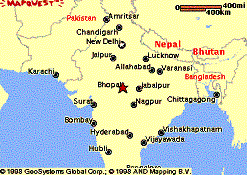
What happened
on December 23, 1984, was what had to be the world's worst industrial disaster
- often referred to as the Three Mile Island of the chemical industry. A result
of technological, industrial, legal and human error, the incident took the
loves of 2,500 people, and injured about 400,000, with the toll still rising to
this day. A leak of the toxic MIC occurred that night when it reacted with a
sizable volume of water that had made its way into the MIC storage tanks.
Action by the staff and supervisors was too late to contain the leak, and forty
tons of MIC flowed out of the tanks over two hours. And even if they had
reacted immediately, the safety standards accepted at the plant would not have
allowed them to do anything about it. Thus the methyl isocyanate gas escaped
into the air and drifted eight kilometers downwind over the city of Bhopal,
population 900,000, poisoning all in its path. The most seriously effected
areas were those nearest the plant, the absolutely poorest sector of the
population.
Team
Assignment
.
Reports must be stapled in the upper left-hand corner and have 2.5-cm margins on all sides. The type font must be Tines Roman 12 points. The line spacing should be 1.5 spacing. Refer to Section 6.6H of Fogler and LeBlanc in writing this report.
- A letter of transmittal must be addressed Dr. Jahan.
- The cover sheet must contain the title of the project, names of individuals in the group with the group leader designated, course number, and date submitted.
- Executive summary: The report must contain a summary, not more than one page in length.
- Project Description
Problem Statement ( 1page)
Background
(Introduction to Bhopal, India) (2 Pages)
Methyl
Isocyanate (3 Pages)
The Union
Carbide Crisis in Bhopal, India (4 pages)
Current Status
( 2 Pages)
Regulatory Impact ( 2 Page)
Ethical Issues
( 2 Pages)
Conclusions (1
Page)
References
Related Links to the Project
http://www.umich.edu/~snre492/lopatin.html#TOC
http://www.bhopal-justice.com/
http://www.ucaqld.com.au/community/bhopal/
http://www.corpwatch.org/trac/bhopal/
Links to India
INDIAN GOVERNMENT: http://sunsite.sut.ac.jp/asia/india/govt/
Geography and Structure of Bhopal, India http://www.incore.com/india/mp.html
Madhya Pradesh: http://www.mp.nic.in/
MIC (methyl
isocyanate ) Links
http://www.lakes-environmental.com/toxic/METHYL_ISOCYANATE.HTML
MSDS info http://www.hmcs.net/
UNION CARBIDE’S HOMEPAGE: http://www.unioncarbide.com/index.html
Links to Regulatory Agencies
Charter on Industrial Hazards and Human Rights http://www.gn.apc.org/pesticidestrust/charter.htm
USEPA http://www.epa.gov/
SARA TITLE III http://www.orcbs.msu.edu/AWARE/pamphlets/hazwaste/saratitle3/purpose.html