|
|
- Purpose
- To demonstrate how electrostatic induction and gravity can be used to separate substantial amounts of opposite charge.
- Location
- Room 146, right, rear corner
- Description
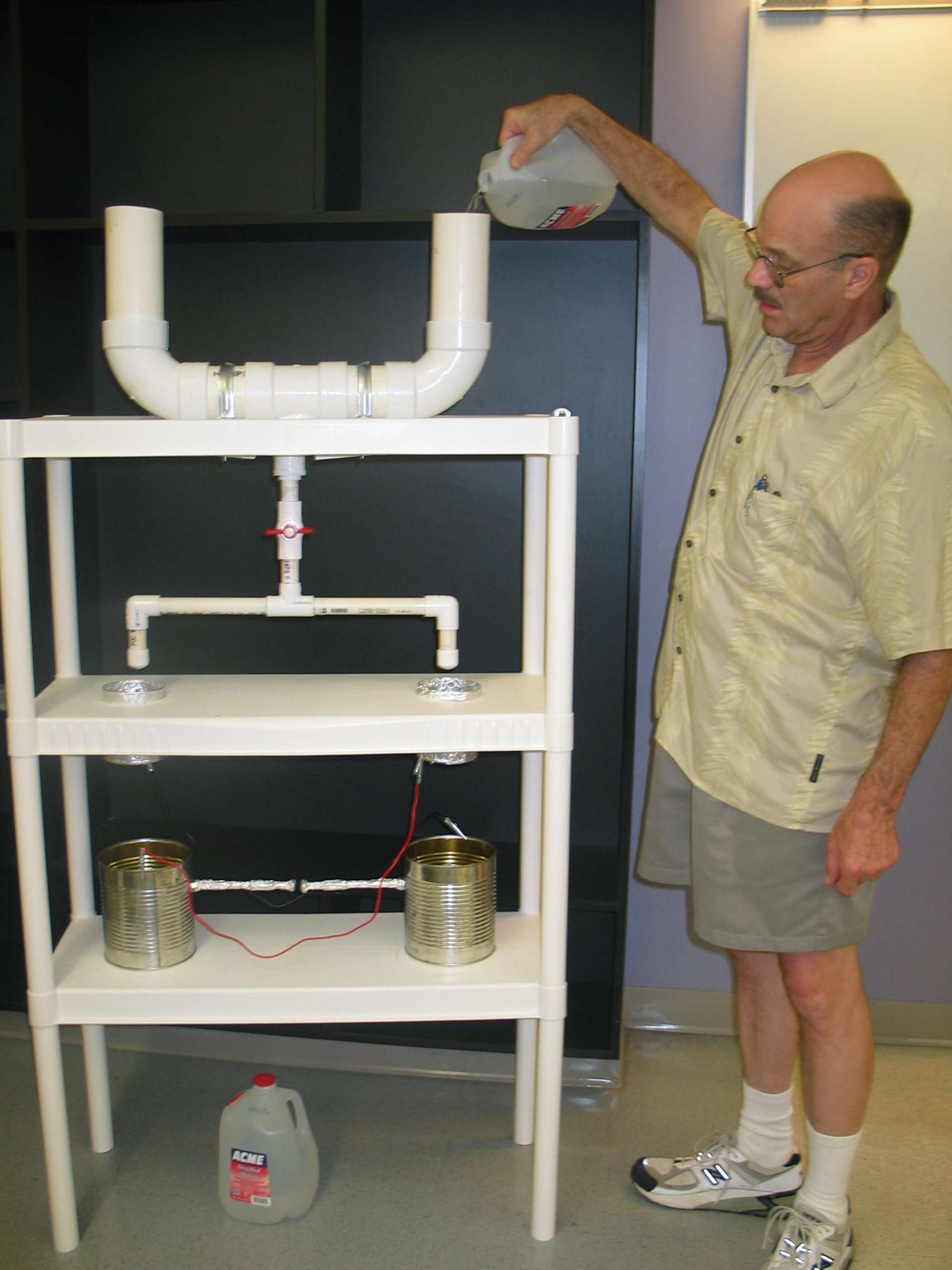
- Set up the apparatus as shown, with the red valve closed (horizontal).
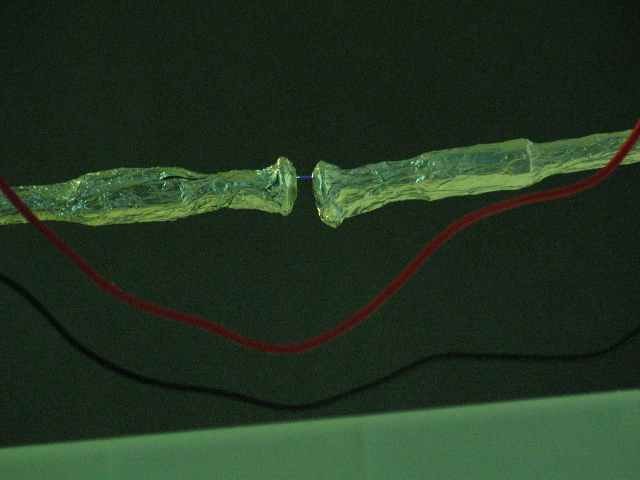
Align the large cans in the circles drawn on the bottom shelf, and connect the right, upper cylinder to the left large can as shown above (red cord with alligator clips). Clip the left upper cylinder to the large can on the right using the black cord (not easily seen in photo). Make sure the cords do not come to close to each other or anything else that could result in a discharge path. With both cans empty, their combined capacity is about 1.5 gal., but 1 gallon of water should be plenty to pour into the top. The device exploits the fact that water droplets falling out of the PVC downpipes acquire slightly different small amounts of charge, and uses inductive feedback to amplify the effect, resulting in a discharge spark between the electrodes (right photo). A description of the design and operating principles may be found at:
http://www.splung.com/content/sid/3/page/electrostatic_machines . The description is summarized below.
Overall, water is electrically neutral but a small fraction of the water molecules form ions and carry either a net positive or net negative charge. Negative ions in the water will be attracted to a positively charged object but the positive ions in the water will be repelled by it. If a drop has a net negative charge when it falls from the downpipe, the negative charge becomes isolated, and charge can be accumulated by catching the water in a metal container. The inside of the container remains neutral, but the negative charge accumulates on the outside of the container.
The Kelvin electrostatic generator has two dripping taps above two metal rings which are �cross-connected� to the two metal buckets (i.e. right to left and left to right). The buckets collect the charge from the drops.
Let us say for the sake of argument, that the first drop falling into the left bucket is positively charged. The positive charge causes the right ring to become slightly positively charged which attracts negative ions to the water drops falling from the tap on the right, causing them to become negatively charged. This negative charge falls into the bucket on the right, which causes the metal ring on the left to become negatively charged, which attracts more positive ions into the water dripping from the left downpipe.
Thus the water is separated into two streams of positively and negatively charged drops, and as water is collected in the buckets the charge on each bucket increases and reinforces the charge on the rings. The charge on the buckets builds up until it is great enough to cause a breakdown in the field across the spark gap, or if the spark gap distance is too great, coronal discharge from sharp edges permits the charge to leak into the air.
|

