|
|
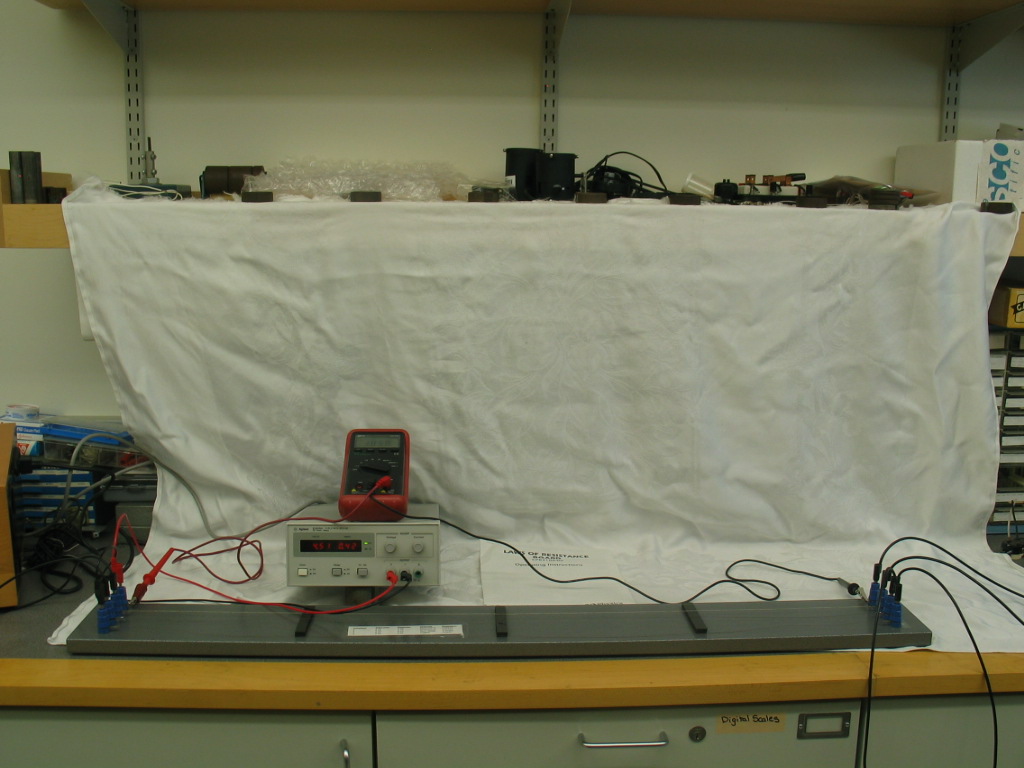
- Purpose
- This board can be used to demonstrate Ohm�s Law as well as how the resistance of a wire depends on its length, cross-sectional area, and material composition.
- Location
- : Room 146; Laws of Resistance Board, shelf V3; HP power supply, shelf C3; multimeter, shelf A4
- Description
- To demonstrate Ohm�s Law, connect terminals 1* and 2* together with a banana plug, and connect the power supply to terminals 1 and 2. Apply 1.5V and observe the current reading on the power supply. Now apply 3V and observe that the current has double. Increase the voltage to 4.5V and 6V and see the current increase at the same rate.
- To demonstrate the law of lengths, use the same connections as above. Turn the power supply on and apply 4.5V. Using the voltage setting on the multimeter measure the voltage drop across 1 and 1* and then between 1 and the midpoint of that wire. The second reading should be half as much of as the first. Repeat this process with wire 2/2*.
- To demonstrate the law of areas, Use the same set up as before. Notice wire 2 is twice as thick as wire 1 but they are the same metal and the same length. Measure the voltage drop across wire 1/1*, then measure the voltage drop across 2/2*. Notice that wire 2/2* has a voltage drop that is only � of the voltage drop across wire 1/1*.
- To demonstrate the law of materials, connect all four wires in series. So connect (1* to 2*), (2 to 3), and (3* to 4*). Now connect the red lead from the power supply to terminal 1 and the black lead to terminal 4. Apply 4.5V across the wires and take measurements of the voltage drops across wires 1, 3, and 4. Notice that these wires are the same length and cross-sectional area, but you get different voltage measurements for each. The only reason to get different readings is because each conductor is a different material. We say each material has a different �resistivity�, which is equal to the product of resistance times cross-sectional area divided by the length of a wire of the material.
|

