|
|
- Purpose
- To demonstrate excitation of the fundamental natural resonance frequency in a metal rod and visualize it by observing nodes and antinodes in the cork dust in a closed air-filled tube.
- Location
- room 146, shelves V5&V6; rosin & leather cloth, J2
- Description
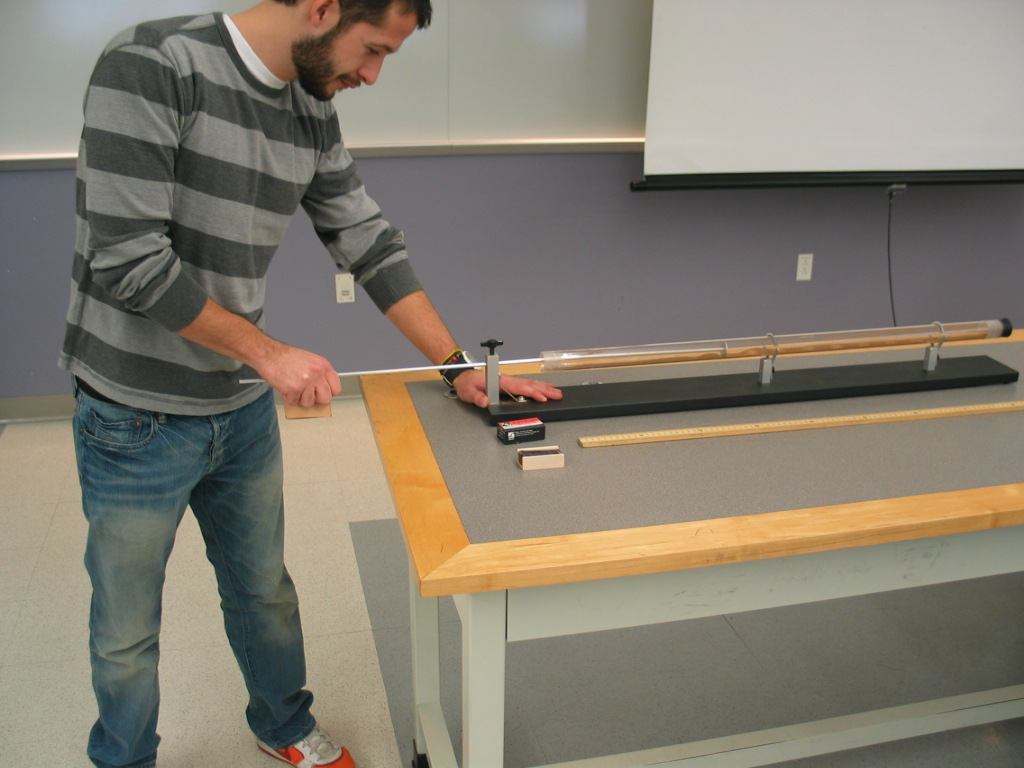
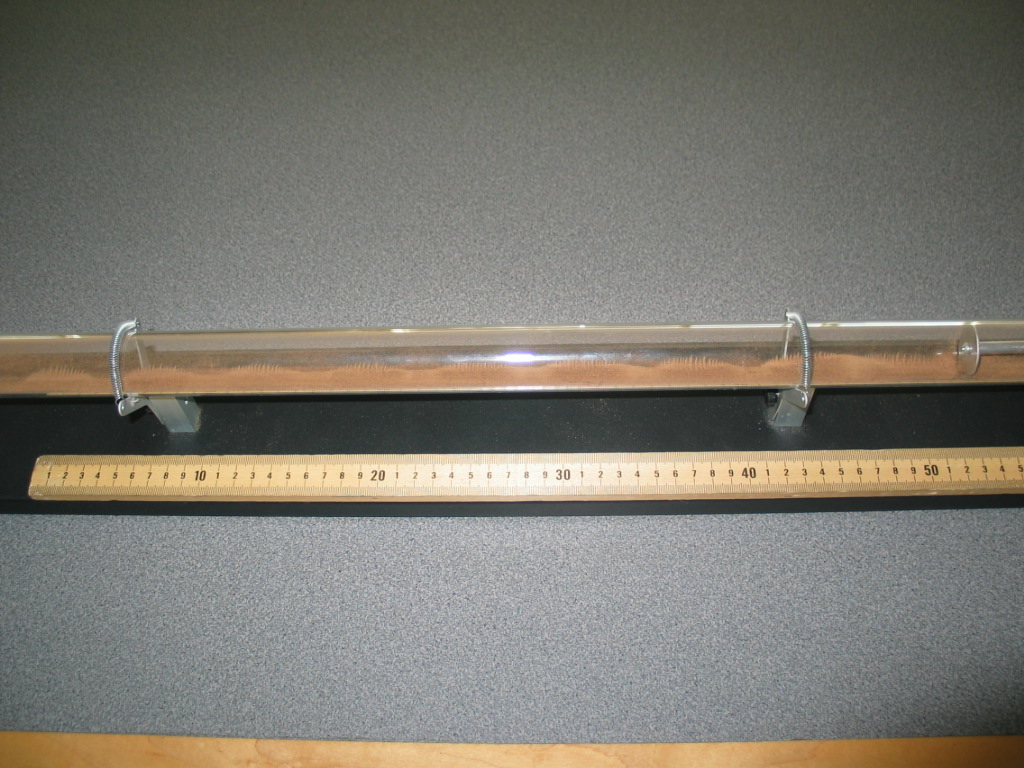
- This demo can be done as a prelude to, or instead of, the second part of the lab �Speed of Sound and Resonance�, which contains more detailed instructions. The metal rod should be clamped at its midpoint, and cork dust should be evenly distributed along the closed glass tube. Rotate the tube slightly so the cork dust is not on the bottom center to facilitate formation of node and anti-node patterns as the antinodes cause the dust to slide to the bottom of the tube. You should hear a screeching sound when firmly pulling the rosined leather clothe along the end of the rod (first photo). You may have to do this several times to create a good pattern in the cork dust. Measure the length of several nodes/antinodes (second photo). The average distance between two nodes equals one wavelength in air. Since we know the speed of sound in air we can then calculate the fundamental frequency. Furthermore, the fundamental wavelength in the rod is twice the length of the rod, so the speed of sound in the rod can also be calculated.
|

