|
|
- Purpose
- To demonstrate how air drag depends on speed and how terminal speed depends on weight.
- Location
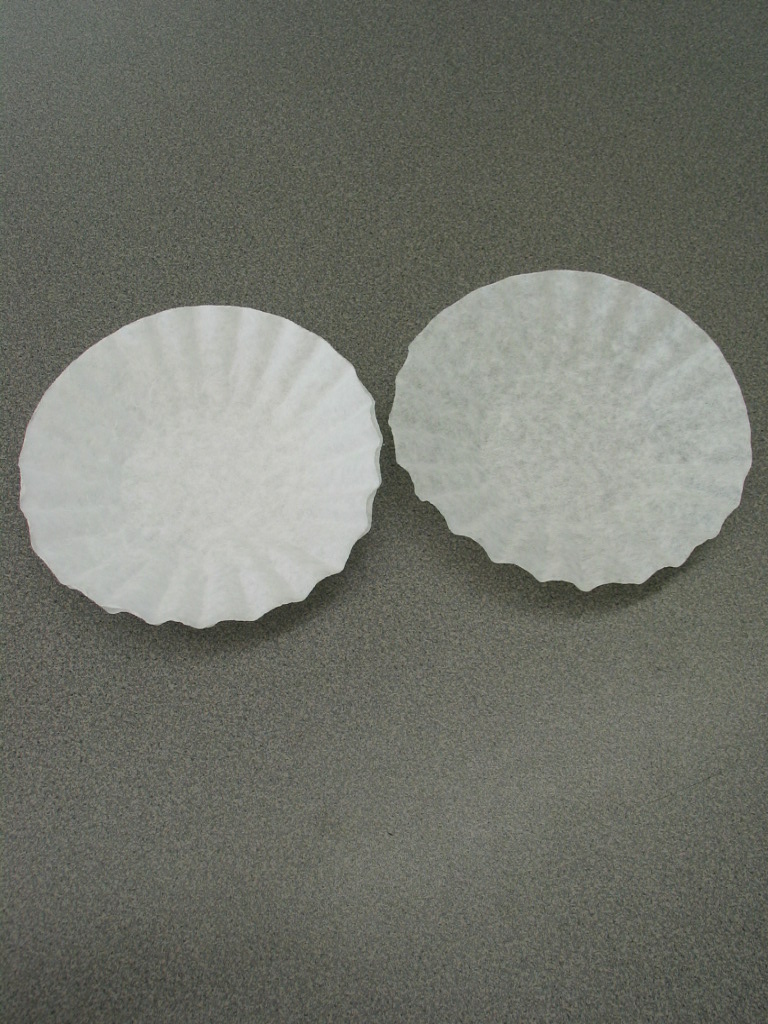
- Room 136: coffee filters (1st photo), shelf L4; 2-meter sticks, shelf U5
- Description
- After defining what is meant by �air drag� and �terminal velocity�. Demonstrate that when dropped, coffee filters quickly reach terminal velocity, v, due to their light weight and large cross-sectional area. (Note: Filters should fall straight down, not swaying sideways.) Next, drop a single filter with one hand and 2 nestled filters from the same height with the other hand to show that the pair of filters falls faster because they have twice the weight. Ask students what the force of air drag must equal (i.e. its weight) when falling at terminal (i.e. constant) velocity.
- Propose two hypotheses for the dependence of air drag, D, on speed, v:
- 1. D is proportional to v, and
- 2. D is proportional to v2.
- Ask students to vote on which they think is true.
- The height, h, from which a filter is dropped and the time, t, it takes to hit the floor, is: h = vt.
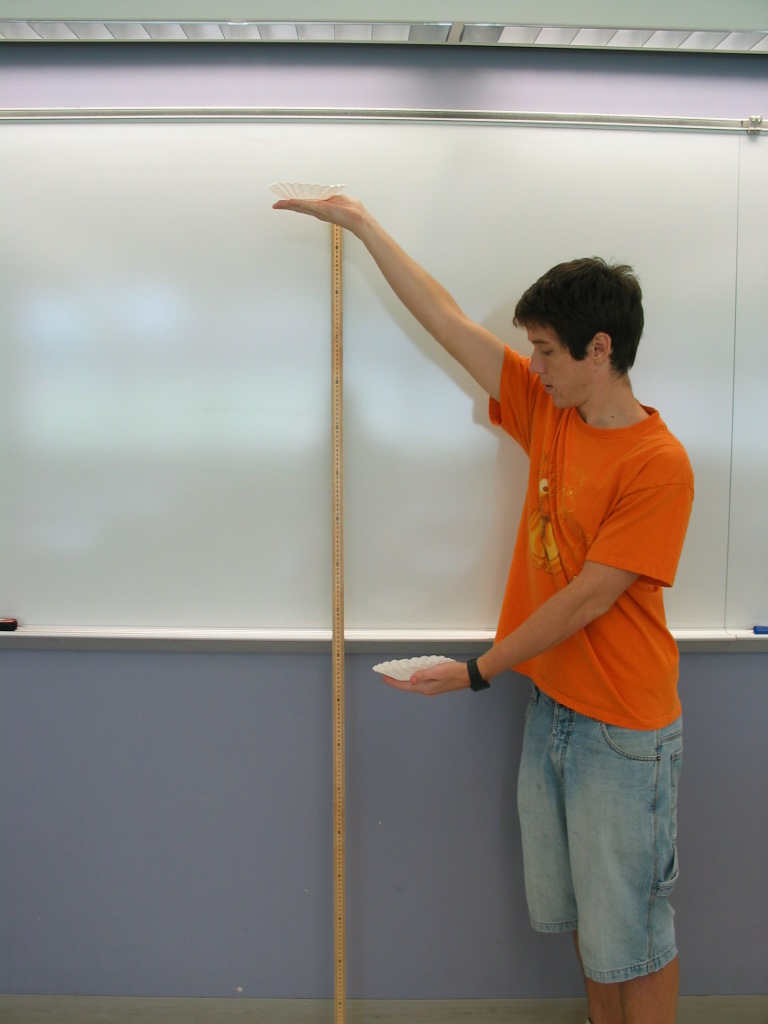
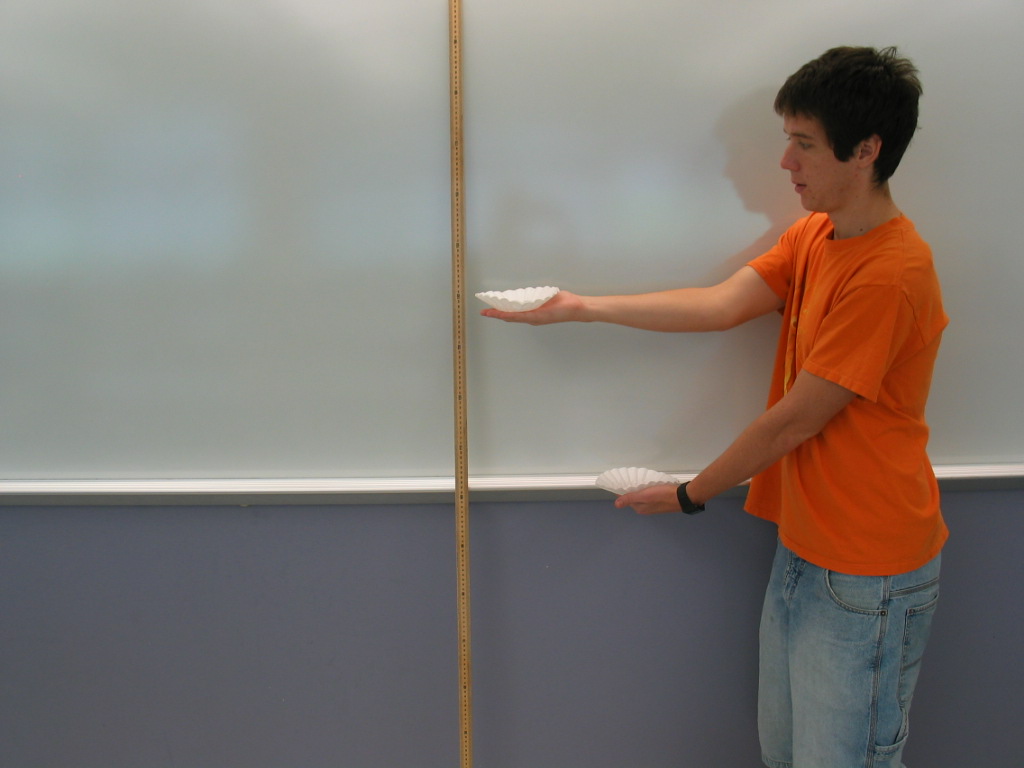
- If 1 is true, then the weight, W, must be proportional to v, since W = D. Therefore h must be proportional to Wt. It follows that a double filter will fall twice as far as a single filter in the same time, t. Test this hypothesis by simultaneously dropping the double filter from a height of 2 m and the single filter from a height of 1 m (2nd and 3rd photos) to see if they hit the floor at the same time. (They won�t.)
- If 2 is true, then W must be proportional to v2, and v must be proportional to the square root of W. Therefore, h must be proportional to √Wt. It follows that a double filter will fall √2 times as far as a single filter in the same time, t. Test this hypothesis by simultaneously dropping the double filter from a height of 1.41 m and the single filter from a height of 1 m to see if the hit the floor at the same time (4th and 5th photos). They should, thus confirming that air drag is proportional to speed squared and that terminal velocity is proportional to √W.
|

