PRIME AGRICULTURAL LAND
 Prime agricultural
land is defined and classified by the Soil Conservation Service
(SCS) based on soil classification and an established set of criteria
that are suitable to maintain extended production of sustainable
crop yields over a prolonged period of time. Soils considered
by the SCS to be ideal are those that meet their designation of
Class I and Class II soils which includes a significant portion
of the Township. The loamy sand and sandy loam phases of the following
soil series meet the physical criteria for this classification:
Aura, Collington, Freehold, Downer, Mariton, Nixonton-Barclay,
Sassafras and Woodstown. These soils dominate those found in the
Township and account for its historical agricultural history.
Prime agricultural
land is defined and classified by the Soil Conservation Service
(SCS) based on soil classification and an established set of criteria
that are suitable to maintain extended production of sustainable
crop yields over a prolonged period of time. Soils considered
by the SCS to be ideal are those that meet their designation of
Class I and Class II soils which includes a significant portion
of the Township. The loamy sand and sandy loam phases of the following
soil series meet the physical criteria for this classification:
Aura, Collington, Freehold, Downer, Mariton, Nixonton-Barclay,
Sassafras and Woodstown. These soils dominate those found in the
Township and account for its historical agricultural history.
 However, to qualify as prime
agricultural land, other SCS criteria must be met. These include
the potential for long term sustained yields, the size of the
parcel and its relationship to other agricultural lands, the proximity
of development to avoid urban-agricultural conflicts, the availability
of water, and the length that the parcel has been and could continue
to be successfully farmed. Coupled to these criteria is the importance
that agricultural production has on the economic base of the community.
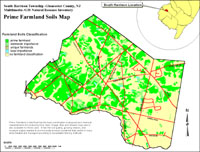
The Prime
Farmland Map represents prime agricultural lands in the Township
in 1995.
However, to qualify as prime
agricultural land, other SCS criteria must be met. These include
the potential for long term sustained yields, the size of the
parcel and its relationship to other agricultural lands, the proximity
of development to avoid urban-agricultural conflicts, the availability
of water, and the length that the parcel has been and could continue
to be successfully farmed. Coupled to these criteria is the importance
that agricultural production has on the economic base of the community.
The Prime
Farmland Map represents prime agricultural lands in the Township
in 1995.
Areas experiencing increased urbanization rapidly lose the
Prime Agricultural Lands classification as the potential rises
for urban-agricultural conflicts. New Development since 1990 threatens
the amount of Prime Agricultural Lands in the Township.
Agricultural lands provide not only food and fiber but also
contribute an important land reserve for future generations, recharge
ground water, help maintain air quality by reducing the amount
of hydrocarbons associated with development. These lands also
serve as valuable fish and wildlife habitat.
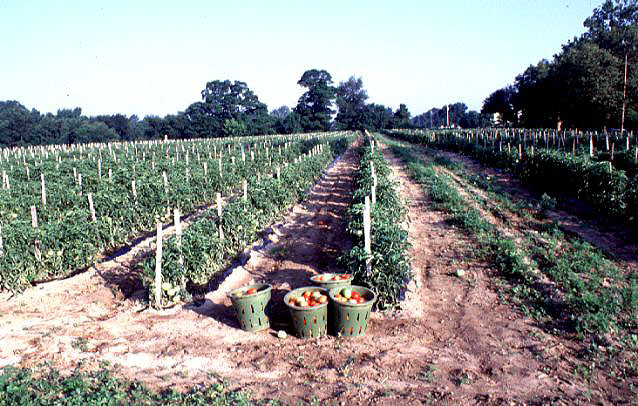 Prime agricultural
land is defined and classified by the Soil Conservation Service
(SCS) based on soil classification and an established set of criteria
that are suitable to maintain extended production of sustainable
crop yields over a prolonged period of time. Soils considered
by the SCS to be ideal are those that meet their designation of
Class I and Class II soils which includes a significant portion
of the Township. The loamy sand and sandy loam phases of the following
soil series meet the physical criteria for this classification:
Aura, Collington, Freehold, Downer, Mariton, Nixonton-Barclay,
Sassafras and Woodstown. These soils dominate those found in the
Township and account for its historical agricultural history.
Prime agricultural
land is defined and classified by the Soil Conservation Service
(SCS) based on soil classification and an established set of criteria
that are suitable to maintain extended production of sustainable
crop yields over a prolonged period of time. Soils considered
by the SCS to be ideal are those that meet their designation of
Class I and Class II soils which includes a significant portion
of the Township. The loamy sand and sandy loam phases of the following
soil series meet the physical criteria for this classification:
Aura, Collington, Freehold, Downer, Mariton, Nixonton-Barclay,
Sassafras and Woodstown. These soils dominate those found in the
Township and account for its historical agricultural history.